
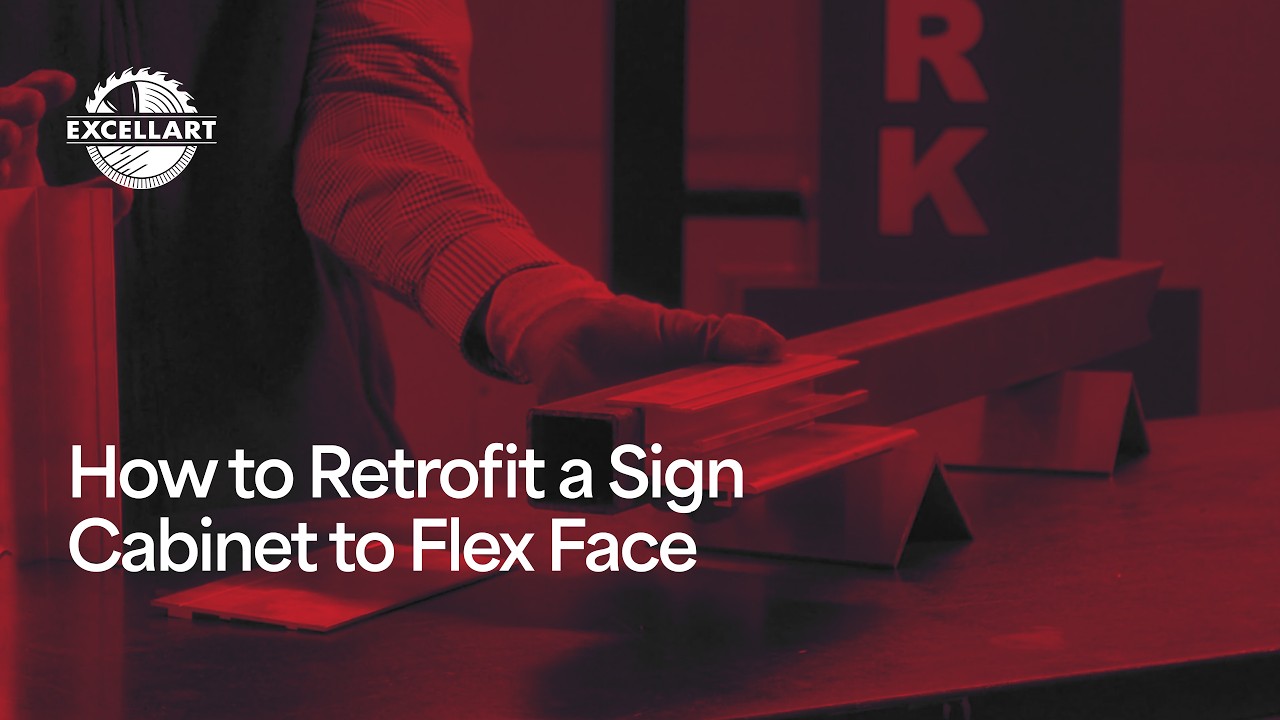
You can convert an existing rigid-face sign cabinet to a flex face without rebuilding the underlying structure. Excellart Sign Products (ESP) offers two retrofit framing options: Flex Retro for straight cabinets and Flex Standard for curved or custom cabinet shapes.
Both systems mount over the existing cabinet framework, allowing sign shops to update the face system while keeping the existing cabinet structure.
Flex Retro for Straight Sign Cabinets
Flex Retro is a low-profile retrofit frame built for existing sign cabinets with straight lines and mitered corners. The trim runs straight and does not contour to curves, so Flex Retro is best suited for square or rectangular cabinets.
Installation follows a simple process: place the flange over the existing tube framework, secure through the flange, stretch and tension the flex face, then cap the system with the trim. The finished retrofit sits low and clean, turning the existing rigid-face cabinet into a flex face cabinet without major structural modification.
Flex Retro is the right option when the existing cabinet is straight, square, or rectangular, and the goal is a clean flex face conversion without rebuilding the cabinet.
Flex Standard for Curved or Custom Sign Cabinets
Flex Standard uses a slightly larger profile and handles more complex cabinet geometry. It works with straight lines, radius corners, circles, ovals, and custom shapes.
Like Flex Retro, Flex Standard uses a flange-over-existing-tube approach. The frame is secured through the flange, the flex face is stretched and tensioned, and the bleed trim is installed after the face is tensioned.
If the existing sign cabinet has any non-linear edges, Flex Standard is the retrofit option. ESP kerf-cuts the frame to follow those curves, so the shape work is handled before the box ships. That lets the shop retrofit curved or custom cabinets without trying to force a straight trim system around a shaped perimeter.
Both Flex Retro and Flex Standard use ESP’s Universal Flex Clip to secure and tension the face. Each clip can be tightened or released with a standard 7/16-inch (11 mm) socket, keeping face installation and service consistent across the retrofit lineup.
What to Measure Before Ordering a Retrofit Frame
Both retrofit frames are sized slightly larger than the existing sign cabinet so they can overlap the existing framework without leaving gaps at the seams. That overlap makes accurate measurements critical.
When measuring the existing cabinet for a retrofit order, use the outermost dimensions of the existing cabinet. These are the dimensions the retrofit frame will sit over.
Also account for any features that affect the overlap, including existing trim, drip caps, hardware, or anything else that extends beyond the basic cabinet frame. Those details matter because the retrofit frame needs enough coverage to sit cleanly over the existing structure.
When a Flex Face Retrofit Makes Sense
A flex face retrofit makes sense when the existing cabinet structure is sound, the location is staying the same, and the goal is to update the face system rather than replace the complete cabinet.
For new construction or full cabinet replacement, an integrated flex face profile may be more efficient because the structural framing and flex face tensioning system are combined in one extrusion.
Find the Right Sign Cabinet for Your Project
Use the Excellart Kit Finder to answer a few project questions and find the right kit configuration. For project-specific questions, or just to chat contact the Excellart team at (800) 627-9044 or hello@excellart.com.